Measuring the value
One screen for a delivery crew's day: 43% of notes posted before the truck delivers, and returns nobody can record
The warehouse posts the delivery note as the truck leaves; the driver's screen read it as "done" and locked the returns field. Over 14 days, early-posted notes had a signed slip 1% of the time and a returned quantity 0.4%, against 89% and 15.5%. Reopen the note for the driver, add a vehicle & fuel tab that reads photos with AI — what that saves a month.
One screen for a delivery crew's day — how much does it save a month?
All it needs is delivery notes per day, the share the warehouse posts before the truck delivers, the number of trucks and the km each one drives a day. Every money figure follows from those. Change any of them.
Derived from the four numbers above
Assumptions — open to see and change every number
Customer returns
Signed delivery slip
Fuel
Matching fuel invoices to trucks
Reading photos
The measured figures are the rates marked "measured"; the rest are illustrative. Set the early share and the trucks to zero and every line goes to zero — try it.
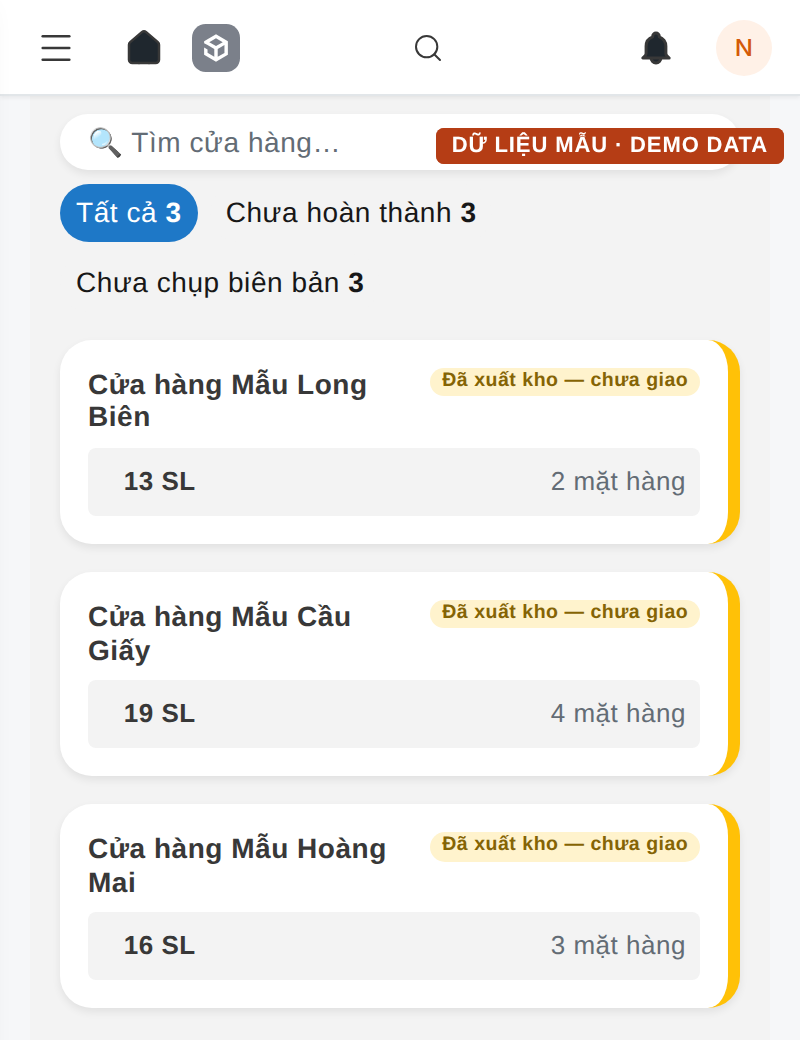
At a fresh-food distributor, the delivery trucks leave the warehouse early in the morning. To keep stock right hour by hour, the storekeeper posts the delivery note the moment the truck pulls out. Sensible — until you count. On the driver's phone, a posted note showed "Completed" and locked the delivered, support and returned fields. The driver saw "done" and never opened the note again: no photo of the signed slip, no returned goods recorded. Returns still happened — nobody could write them down.
We measured 14 days at that company. 43% of notes (737 of 1,722) were posted before the truck delivered. Of those, only 1% had a signed-slip photo (8 of 737), against 89% (150 of 168) on notes the driver completed; and 0.4% had a returned quantity (3 of 737), against 15.5% (153 of 985). Meanwhile the fleet sent odometer and pump photos into a group chat, and some 170 fuel e-invoices arrived over three months without being tied to any vehicle.
The change in this article is one screen for the driver's whole day: the "Deliveries" tab accepts notes already issued from stock, and a "Vehicle & fuel" tab replaces the group chat. We work out how much a month that saves, and which assumptions the number stands on.
1. What changes
A note issued from stock still waits for the driver
- The list shows "Issued — not delivered", not "Completed". Stock posted as the truck leaves is not goods in the customer's hands, and the screen now says exactly that.
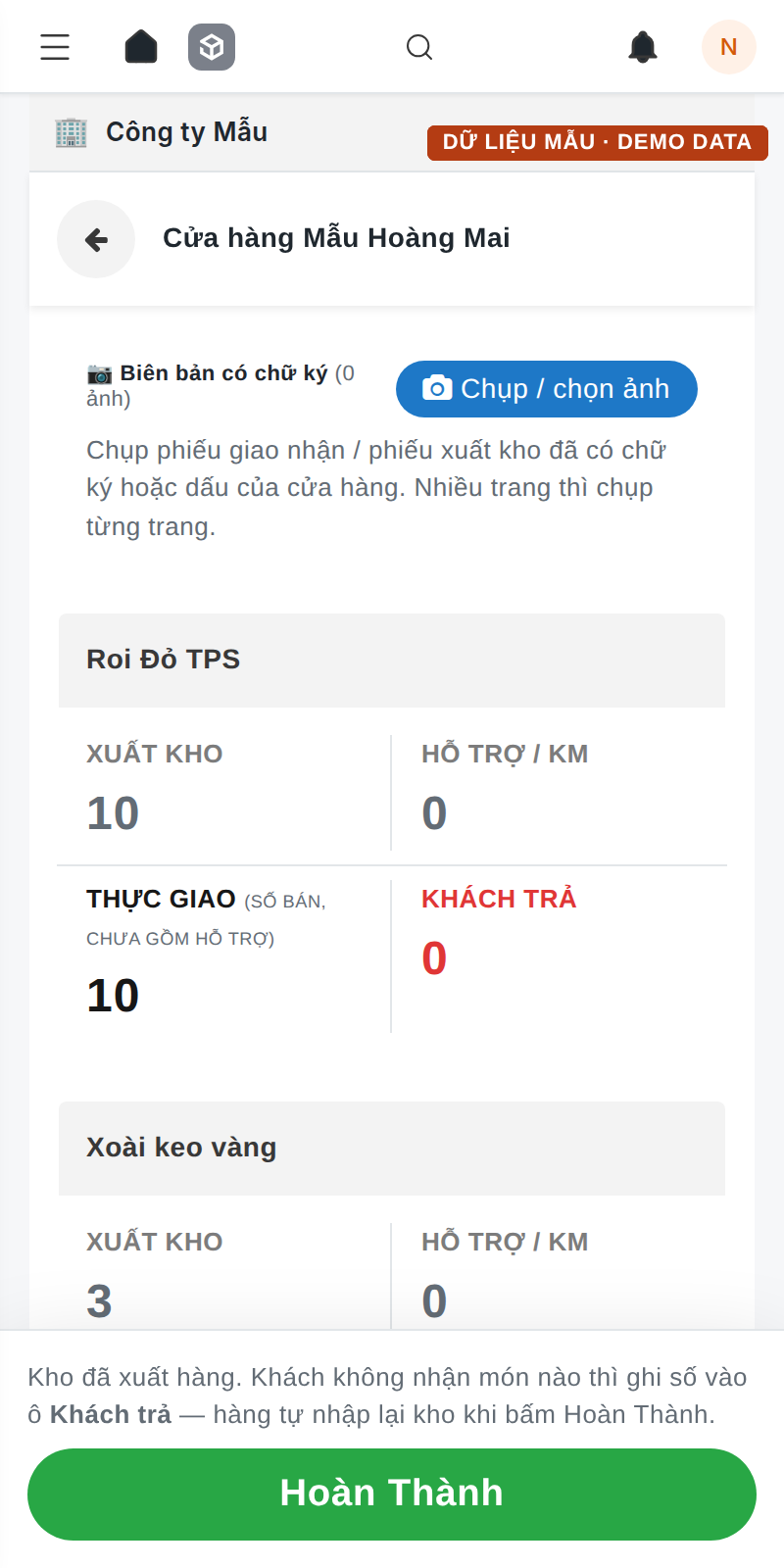
- Delivered, support and returned can still be recorded. The quantity issued from stock does not change — these three are recorded figures. Every edit keeps its history: who, when, old value to new value.
- Pressing Complete turns the returned goods into a stock receipt — into a clearance warehouse or back into the selling warehouse, configured per company, because some returns can still be sold. Change the returned figure later and the receipt is rebuilt to match.
- A note that already has an invoice is locked, and the message says who to ask: accounting.
The "Cancel" button also disappears on an issued note; in its place is one line: if the customer refused an item, record it as returned. This continues the article on customer returns and the one on signed delivery slips: the mechanism existed, half the notes simply could not reach it.
Vehicle & fuel
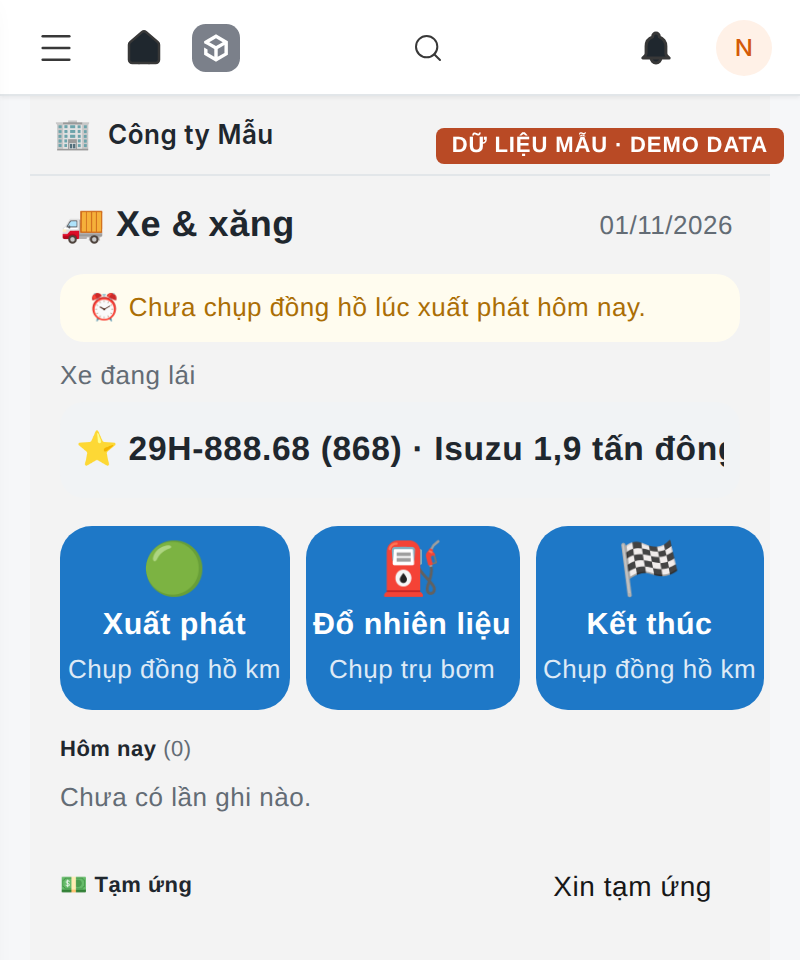
- The driver picks a vehicle (the phone remembers the last one), presses one of three buttons — Start, Refuel, Finish — and takes a photo.
- The AI reads the number on the odometer, or the litres, unit price and amount on the pump, and checks litres × price = amount. The figures appear under the photo; the driver taps "Correct" or fixes them.
- Each refuel becomes a draft fuel expense claim, deducted from any open cash advance. The fuel station's e-invoice that arrives later is matched to the refuel by amount, litres and date.
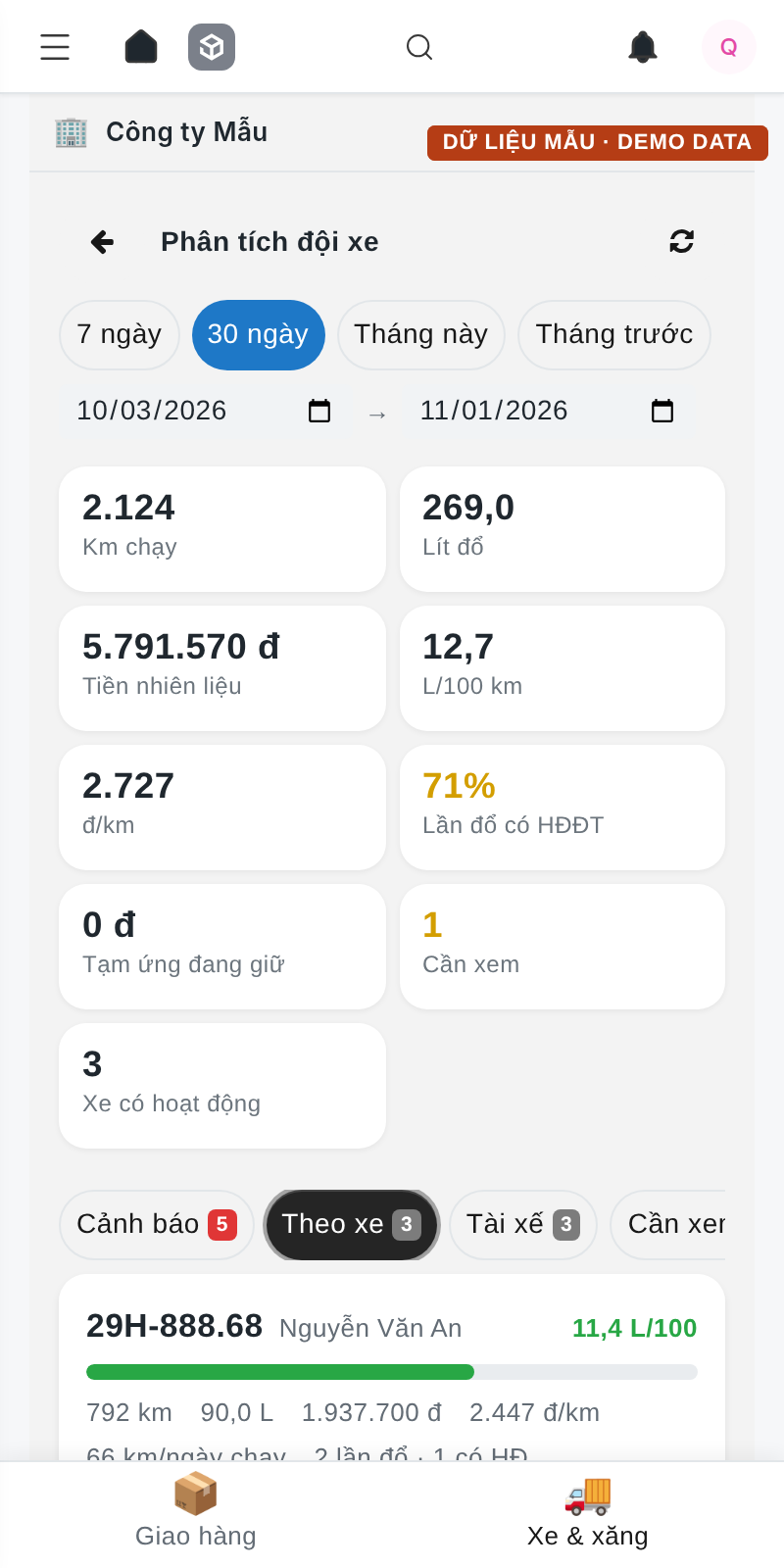
- The manager gets an analysis button: kilometres, litres, money, L/100 km and cost per km by vehicle and by driver; and alerts — over the norm, odometer going backwards, more fuel than the tank holds, idle vehicle, overdue advance, invoice with no vehicle.
2. How well the machine reads photos
We ran the reader on 11 real photos drivers took in one day. 8 the machine marked "confident" — checked by eye, all 8 right: five- and six-digit kilometre readings on five different dashboards, and one pump at 66.375 L × 31,640 = 2,100,105 VND. 3 the machine flagged "not sure" itself: two taken at night, one with glare. None was read wrong while marked confident.
The rule follows: on a "not sure" photo the driver checks the number on the spot and fixes it if needed; if the driver changes the amount read from a pump, the claim waits for the manager, because that is money. A changed kilometre reading is only logged — a night shot of a dashboard is hard to read, and that is normal.
3. First stream: returned goods make it back to stock
How to measure. A month after the change, count early-posted notes with a returned quantity. If the rate climbs towards the 15% of driver-completed notes, the extra count is exactly the returns that used to fall through. Value per return comes from the returned-goods receipts themselves.
Confidence: high on the count (both rates were measured), low on the money — 150,000 and 30% are illustrative, and this is the largest line in the article.
4. Second stream: quantity disputes avoided thanks to the signed slip
Confidence: low. The slip rate was measured; the dispute rate and dispute value nobody has counted. A slip is evidence — its value only shows on the day someone argues.
5. Third stream: fuel over the norm
How to measure. L/100 km only means something over a period of a week or more: drivers fill by round amounts, not to a full tank, so a single refuel gives a meaningless figure. Set a norm per vehicle, run four weeks, compare each vehicle's L/100 km with its own norm.
Confidence: medium. Before the change there were no kilometres anywhere, so nobody knows today's overrun — 5% is an assumption, and the first four weeks exist to replace it with a real number.
6. Fourth stream: hours matching fuel invoices to vehicles
Confidence: medium. The smallest line, but the one accounting feels most.
7. To subtract: reading photos
About 2.4 photos per vehicle per day (start, finish, the occasional refuel), 1,000 VND per read: about 0.75 million VND a month for 12 vehicles. It is the only line in the chart that goes up.
8. Adding it up
| Line | Per month | Per year |
|---|---|---|
| Returns back to stock | 10.52 m | 126.2 m |
| Disputes avoided by the slip | 2.72 m | 32.7 m |
| Fuel overrun recovered | 1.21 m | 14.5 m |
| Hours matching fuel invoices | 0.63 m | 7.6 m |
| Reading photos | −0.75 m | −9.0 m |
| Net benefit | 14.33 m | 172.0 m |
Amounts in VND.
The slope chart in the calculator draws each line from "before" to "after" on one money axis. Four lines go down, one dashed line goes up. What it shows most clearly: nearly three quarters of the money is in customer returns — that is, in fixing one status label and unlocking three number fields, not in the AI.
9. What this ROI stands on
The share of notes posted early. Here it is 43%. Where the warehouse waits for the driver to complete before posting, the first two lines are zero — and that is the right answer: the problem does not exist there. Set this field to 0 in the calculator to see it.
Value and loss share of a return. These two numbers decide the largest line, and both are illustrative. Returns that can be resold lose little; fresh produce loses a lot.
Whether drivers actually record. Unlocking a field makes nobody fill it in. The yardstick is the share of early-posted notes with a slip and a returned figure after a month — if it does not move towards 89% and 15%, the benefit has not arrived.
The overrun share. Without kilometres there is no norm to exceed; 5% is only a place to start.
Set the early-posted share and the number of vehicles to 0: every line goes to 0, cost included.
10. Measure it at your own company
- Take a baseline. Count 14 days of delivery notes along the two paths — posted before delivery, and completed by the driver — and compare the share with a slip and with a returned figure. The gap between the two is what is falling through.
- Set a norm and tank capacity for each vehicle before switching on the photos, so the first week already has something to compare.
- Measure again after 7 and 30 days: slip rate, return rate, number of returned-goods receipts, L/100 km per vehicle, share of refuels matched to an e-invoice — then replace the calculator's numbers with real ones.
11. What to remember
One wrong status label can hide half the work. Posting stock early is right for inventory; the driver's screen reading it as "done" is wrong for everything that follows. Fixing that is cheaper than any AI in this article, and worth more.
The system did not lose the returns. It just left no place for the person who wanted to record them.
Figures marked as measured come from 14 days of live operation at a food distributor, anonymised; the 11 odometer and pump photos are real and were checked by eye. The value per return, dispute rate, number of vehicles, kilometres, norm, fuel price, overrun share and AI cost are illustrative. Screenshots were taken on sample data. Replace them with your own numbers.
Read next
-
Make-up orders from a supermarket chain: one PO in 26, and only the receipt tells
A store raises a PO and receives it the same day to pay back goods already delivered without one. The PO header still says "deliver tomorrow", so a make-up order is easily delivered twice and the goods behind it never invoiced. Measured on 1,258 POs, with a matching threshold chosen from the data.
-
Exceptions that arrive with a reason: 82 slips to check, but only 68 need someone to think
When invoices to supermarket chains raise themselves, the remaining slips reach the accountant with a reason in words. Read by what has to be done, the reasons fall into three kinds: judgement, wait, one-time fix. Measured on 291 slips, and the price of the minutes spent searching.
-
Trying Zalo-in-ERP with no sign-up: in the real inbox after 2 seconds — and nobody stayed 30
A trial page puts the visitor straight into the real ERP inbox, a sample message just arriving, no form, no password. 43 visits from ads: 35 reached the inbox within 2 seconds, 5 stayed 10 seconds, none stayed 30. What a demo costs, and how much of it a trial can replace.