Every partner has its own print standard, so every document detours through Word. Mapping templates to customers sounds like a small interface tweak — measured, it pays for itself inside a month at mid size.
How long until it pays for itself?
All it needs is the size of the sales team and the time each document currently costs. Volume, hours and cash follow from those — every one of them editable.
Derived from your scale
Assumptions — click to see and change every number
Volume and labour
Deal value
Error risk
Implementation
This is an estimate, not a promise. 'Deals won by answering first' is the softest of the three — if you do not believe it, set that rate to zero and read the total again.
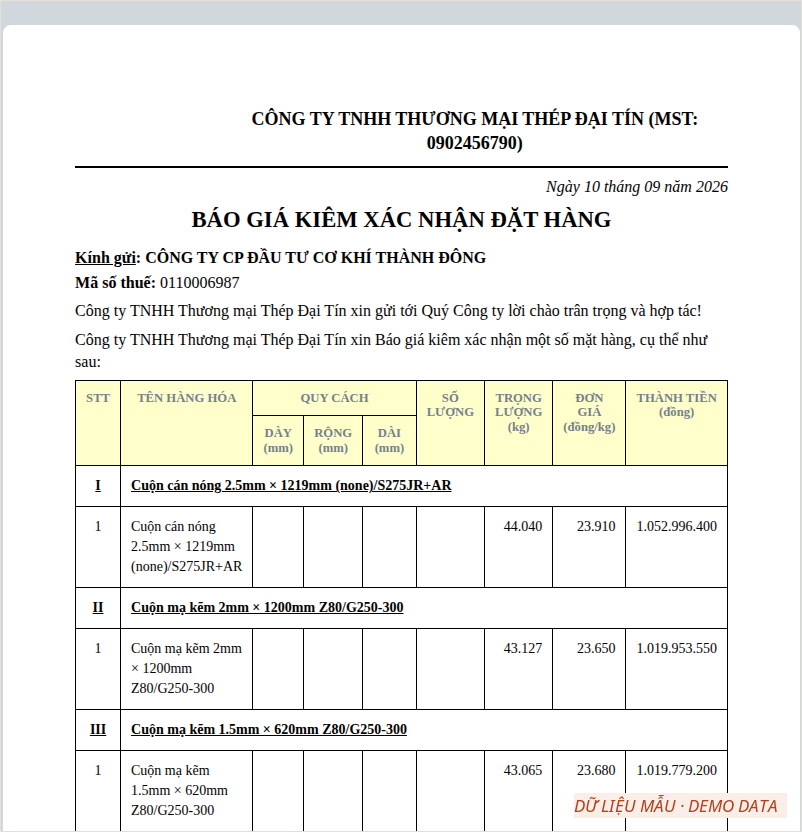
In B2B selling, quotations and contracts are the link that touches the customer directly and creates the revenue. They are also the step with the most manual handling, because every kind of partner — large groups and foreign-invested firms above all — has its own print standard, penalty clauses, column structure and payment details.
Mapping a template to each customer looks like a small interface tweak. This piece quantifies it, and the answer is an unusual one: at a mid-sized company it pays for itself inside a month.
1. What one shared print template costs
With a single default template, three costs appear, and only the first is visible.
- Manual work outside the system. Someone exports to PDF or Word, pastes into the customer's own template, fixes the margins, changes the font, drops in the partner's logo. On average 30–45 minutes per document.
- Clauses drifting out of line. Once a document is edited by hand on a personal machine, sending last quarter's version, dropping a delay-penalty clause, or carrying an old bank account number all become realistic.
- Knowledge stuck in one head. Whoever inherits the account does not know the customer's unspoken conventions, so the paperwork comes back rejected. This is precisely what a compounding system is supposed to hold on the company's behalf, instead of leaving it with the person about to resign.
2. What the improvement actually is
Not a new button. It moves the template from being an action to being an attribute of the customer:
- Set it on the master record. The default quotation and contract templates live on the customer itself.
- Load the right one automatically. Raise a quote for customer A and the system pulls A's print format, A's clause set, A's specific fields. Nobody has to remember.
- Lock what must not be edited. Material clauses stop being editable at will, outside anyone's sight.
This is the shape the previous piece called a compounding system: one more customer with its own standard means one more row of data, not an edit to the source code.
3. Three numbers, and which one to trust
A. Hours recovered
The firmest of the three, because it rests only on time you can measure. Put a stopwatch on ten documents and you have your baseline.
B. Deals won by answering first
Getting a quote out in the first fifteen minutes, while the buyer is still comparing suppliers, is a real advantage. But it is the softest of the three, because separating deals won on speed from deals won on price is genuinely hard. The estimator defaults to a 0.1% uplift; if you have not measured it, set it to zero and read the total again. What remains is still large.
C. Disputes and penalties avoided
Rare, and expensive when it happens. One wrong delay-penalty clause, or one stale bank account, is enough to erase a full year of the hours saved above.
4. Three sizes, one conclusion
The table below comes from the source figures. The estimator reproduces all three columns — the hours line matches exactly, and the totals sit within 6%, because B and C were always estimates.
| Measure | Small | Mid | Large / FDI |
|---|---|---|---|
| Salespeople | 5 | 15 | 40 |
| Documents per month | 100 | 450 | 1,600 |
| Hours recovered | 42m | 243m | 1.20bn |
| Won by answering first | 4.5m | 60m | 450m |
| Disputes avoided | 5m | 30m | 150m |
| Implementation cost | 15m | 25m | 45m |
| Pays back in | ~3.5 months | ~27 days | < 10 days |
5. Why do this one first
The headcount lever. From fifteen salespeople up, manual reformatting already equals one full-time person. The company is paying a salary whose only job is reformatting documents — the money is simply spread across everyone's payslip instead of sitting on one.
Technical risk near zero. It touches no ledger, no stock, no approval flow. If it goes wrong it goes wrong on a printout, and a printout is fixed in minutes.
It buys credibility for the hard parts. Sales teams resist ERP more than anyone, because most changes make them type more rather than less. This is one of the few improvements they feel in the first week. That is what earns patience for the modules whose benefit only shows up months later.
The improvement worth doing first is not the largest one. It is the one that can prove its value earliest — because that is what buys the patience the rest of them need.
The figures here illustrate three company sizes and are not taken from any client's system. Replace them with your own in the estimator above before quoting them anywhere.