Measuring the value
Sharing an estimate by one link: what the mailed-Excel loop costs, and "which version is the latest?"
An estimate passes through 2–4 people as Excel files sent by mail, so someone always asks "which version is the latest?". When the whole set — drawings, quantity table, where every number comes from — sits behind one shared project, with people invited by email or sent a view-only link that needs no account, how many hours a month does the review loop get back?
How many people does one estimate pass through, and how many hours does each round of files cost?
All it needs is the estimates per month, the people in the loop, the review rounds and an hourly cost. Files mailed, reviews and reviews made on an old copy follow from those. Everything is editable.
Derived from the four numbers above (per month)
Assumptions — open to see and edit each one
The assumption every line stands on
Sending files
Working on an old copy
Asking where a number comes from
To subtract
An estimate, not a promise. Line B is the softest — set both "old copy" shares equal and read again. Set the share of the loop working in the shared project to 0: every line goes to zero, the subtraction too. An honest model has to be able to do that.
An estimate rarely passes through one pair of hands. The estimator takes off quantities and prices them; a checker goes
over it; a consultant reviews it or the client looks before approving. Two to four people, and between them Excel files
sent by mail: estimate_v3.xlsx, estimate_v3_rev.xlsx, estimate_v3_final_rev2.xlsx. Every round of comments adds a
copy, everyone keeps the copy they received, and the question asked most often in the whole process is: "which version
is the latest?"
The second question follows right behind: "where does this number come from?" The checker sees an odd quantity and asks; the estimator opens the drawing set, finds the page, takes a screenshot, mails it back.
This piece asks: if the whole set — drawings, quantity table, where every number comes from — sat behind one project that everyone opens, how many hours a month would that file loop give back?
1. What changes
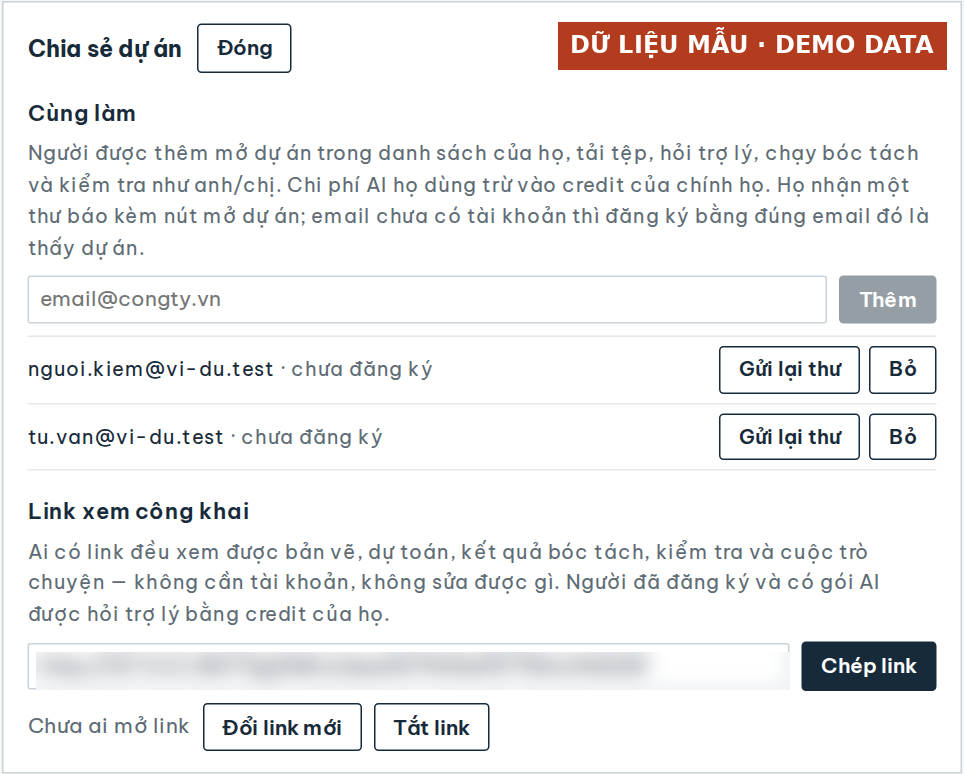
The project owner presses "Share" and has two ways, used apart or together:
- "Work together" by email. The person added sees the project in their own list and works on it like the owner: uploads files, reads drawings, edits the quantity table, asks the assistant. Everyone pays for their own AI use — each question is charged to the credit of whoever asked it, including the automatic read of a newly uploaded file (the uploader pays). They get a notice by mail with a button straight to the project; an email with no account yet sees the project the moment someone signs up with that exact address. Adding the same email again sends nothing; to remind them, press "Resend".
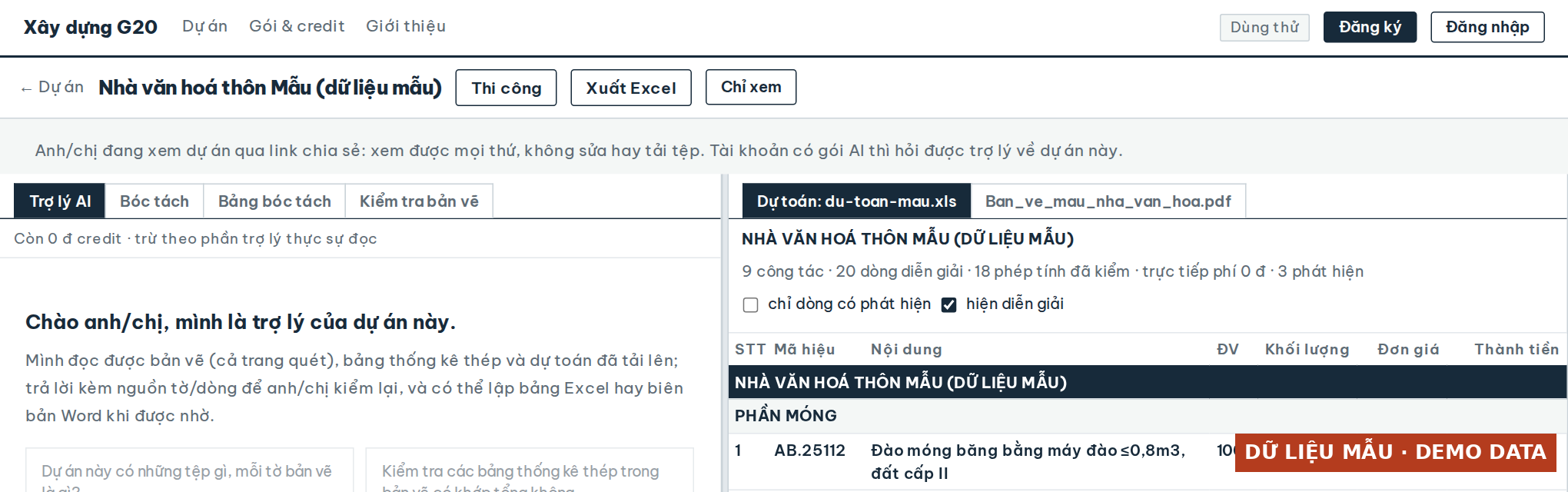
- A public view-only link. Anyone with the link can see the drawings, the estimate, the quantity table, the check results and the conversation — without creating an account, and without editing or uploading anything. A signed-up account with an AI plan may ask the assistant about the project on its own credit, but the assistant may not write to the project in that turn. "New link" invalidates the old one and removes everyone who came in through it; the owner sees how many people have opened the link.
Only the owner adds or removes people, manages the link and deletes the project. In the conversation each question shows who asked; other people's AI costs are not shown.
One technical detail is worth stating because it is where this kind of feature goes wrong most easily: every function of a project requires edit rights by default, and only functions explicitly marked "read" open to someone viewing by link. A new function somebody forgets to mark refuses the viewer; it does not quietly let them edit. The sharing test was run against the old default first — and failed — before it passed.
2. First stream: sending and receiving files
Each round, the estimator sends the new version to each reviewer and each reviewer sends comments back: two files per reviewer. A mailed file costs effort at both ends: save the new version, name it, attach it, write a few lines; on the other side, download it, search the folder for which one is newest, open it and compare with the last.
How to measure it. Take last month's mailbox and count the messages with an estimate file attached, per estimate. Ask the estimator and one reviewer how long each send or receive takes, finding the newest version included.
How far to trust it: fair. Messages can be counted; minutes per file differ a lot between a tidy person and one whose downloads folder holds hundreds of copies.
3. Second stream: reviewing a superseded copy
This is the real price of "which version is the latest?". The checker comments on v3 while the estimator has already moved to v4; the comments have to be matched line by line, part of the work is redone, and sometimes a fixed error is "fixed" back.
How to measure it. Ask the estimator: in the last three months, how many times did comments turn out to be written on an old copy, and how long did each take to untangle? A remembered number is imprecise, but better than this article's 10%.
How far to trust it: low — the softest line. Set both "old copy" shares equal and the calculator still leaves 10.7 hours a month.
4. Third stream: questions about sources
How to measure it. Count questions of this kind in the mail thread of a finished estimate.
How far to trust it: fair — on one condition: only quantity rows already tied to a drawing page answer the question by themselves. A row typed in with no source still gets asked about. And the drawing page is quick to find only when the whole set, scanned pages included, carries text — measured separately in the piece on searching scanned drawing sets.
5. To subtract: inviting people
Inviting one person to one project takes about 2 minutes: type the email, check they received the notice. 2 reviewers × 4 estimates: about 0.2 hours a month. Sharing adds no AI cost of its own: whoever asks the assistant pays for it, and that is not in this calculator.
6. Adding it up
| Stream | Hours/month | Money/month (VND 80,000/h) |
|---|---|---|
| Sending and receiving files | 7.7 | 0.61 m |
| Rework after reviewing an old copy | 5.2 | 0.41 m |
| Questions about sources | 3.2 | 0.26 m |
| Inviting people | −0.2 | −0.02 m |
| Given back | 15.9 | 1.27 m |
About 16 hours a month, spread across the loop — estimator, checker and consultant — on 4 estimates. About VND 15 million a year at the salary in the example. Today the file loop takes about 24.5 hours.
Counted once. These hours are money or capacity to take on more work, never both. And they are spread over several people: for the estimator most of it sits in the first and third streams; for the checker, in the second.
7. What this ROI stands on
People really work in the shared project. That assumption sits under all three streams. If the consultant still says "send me the Excel file" and every comment goes back through the mail, no hour comes back. Set that share to 0 in the calculator: every line goes to zero, the subtraction too. The view link that needs no account exists precisely because of this assumption — the person receiving it does not have to sign up just to look.
The link does not replace the official submission. The estimate submitted for approval is still the signed file or paper the rules require. The shared project shortens the rounds before that submission; it does not replace it.
Anyone with the link sees everything, the conversation included. A link forwarded outside is a set of documents gone outside. When a party leaves the project, press "New link"; for someone who will work on it for long, use "Work together" by email rather than the link.
The 10% share of reviews on an old copy is the number in this piece most likely to be wrong. Measure before you trust it.
8. Measuring it in your own company
- Take a baseline. Pick an estimate you have just finished. Count the messages with attachments and the questions about sources, and ask how many times in three months a review was done on an old copy.
- Run one estimate in a shared project. Invite the checker by email, send the consultant a link. Note how many files still went by mail, whether the reviewers opened the link, and how many source questions still had to be answered by hand.
- Compare like with like. An estimate with three rounds of comments differs from one with a single round; compare many rounds with many rounds.
9. What to remember
A set of documents should have one place to live. When an estimate lives in five mailboxes, every copy looks like the final one and none of them knows which is newer. Put it in one place, and "which version is the latest?" has nowhere left to be asked.
The most expensive question in a review round is not "is this number right" but "is this the latest version".
The ways of sharing, what each kind of viewer may do, everyone paying for their own AI use, and the default-permission test are described as they stand in the Xây dựng G20 tool at the time of writing. The screenshots come from a sample project; the emails are sample addresses. Estimates per month, people, rounds, minutes per file, the share of reviews on an old copy, questions and salary are illustrative. Replace them with your own.
Read next
-
Never invoice twice: ask the accounting ledger before creating — 199 of 209 invoices were already there
When invoicing moves from the accounting package into the ERP, there is a stretch when both create invoices. If the ERP asks the accounting ledger before it creates one, how many duplicates does a cutover avoid — and what is each duplicate you never clean up worth?
-
Invoicing at the original PO price: the delivery note says 21,000, the chain's PO says 30,000
A retail chain pays the price on its own PO, not the price on the supplier's delivery note. When a machine reads the PO price, invoices at it when the gap is plausible and corrects the price list for next time, what is that worth a month — and which lines still need a person?
-
Searching a scanned drawing set: 171 pages recognised in 338 seconds, and the paging hours that come back
In a drawing set, a scanned page yields nothing to Ctrl+F; looking up a mark means paging. Once every scanned page is recognised into text — text pages and scans counted separately, an interrupted run resuming where it stopped — how many hours a month does an estimator get back, and does the largest set even finish?