Measuring the value
A site diary generated from one plan: 30 pages say "Sunny", the month had 18 rainy days
On a real construction-management workbook, 132 of 330 schedule rows were copies of the price annex and every diary page said "Sunny". When the diary, the acceptance records and the payment quantities come from one plan joined to the quantities, how many hours a month does an engineer get back?
How many hours a month does a site engineer spend copying the plan into paperwork?
All it needs is the number of sites, the jobs in each schedule, the months of construction and an hourly cost. Pages, records and payment periods follow from those. Everything is editable.
Derived from the four numbers above (per month)
Assumptions — open to see and edit each one
Counts
Diary
Acceptance records
Payment quantity statement
Documents sent back
Setup
An estimate, not a promise. Line D is the softest — set both return shares equal and read again. Set the pre-filled minutes equal to today's: every line goes to zero except setup. An honest model has to be able to do that.
Open the construction-management workbook of a site engineer on a publicly funded restoration project and turn to the diary sheet. Every page records the weather as "Sunny", two site engineers, nine workers — every day exactly like the day before. Against the archived readings of the weather service for that very area, September had 18 days with rain during working hours, 9 of them with 2.5 mm or more.
Nobody set out to write it wrong. The diary is made by copying yesterday's page, changing the date, editing a few lines of work, then printing page by page. On the next sheet, 132 of the 330 rows in the job list are near-verbatim copies (95% alike or more) of a line in the contract price annex; 277 rows are at least 60% alike. The same job is typed at least twice, and the two copies are not joined: change a quantity in the annex and the schedule never hears of it, while the acceptance record is typed a third time.
This piece asks: if the diary, the acceptance records and the payment quantity statement were all generated from one plan, joined to the price annex, how many hours a month would an engineer get back?
1. What changes
The engineer imports the very Excel file already in use — the price annex and the job list. Columns are recognised by their header text, so a workbook that differs from site to site still reads. Then:
- Every schedule row has its own code, joined to the code of a quantity line. The machine suggests the most similar annex line for each job; the engineer confirms it. Until confirmed, the quantity reaches neither an acceptance record nor a payment.
- Jobs have a standard order. Excavation before blinding, foundation concrete before foundation masonry, structural concrete must reach its age before the cube test. A job starting earlier than its predecessor allows is marked ⚠ — the machine only marks it, it does not move it. On the workbook above, about a quarter of the jobs were marked.
- The diary fills itself: the jobs in progress and the day's acceptances come from the schedule, the workforce from the site's defaults, the morning and afternoon weather from real readings at the site's coordinates — and all of it can be edited. Once a day is locked, its content stays put even if the schedule changes later.
- Acceptance records and the statement of completed quantities print pre-filled with the record number, quantities and signatories; the payment statement sums the records accepted within the period.
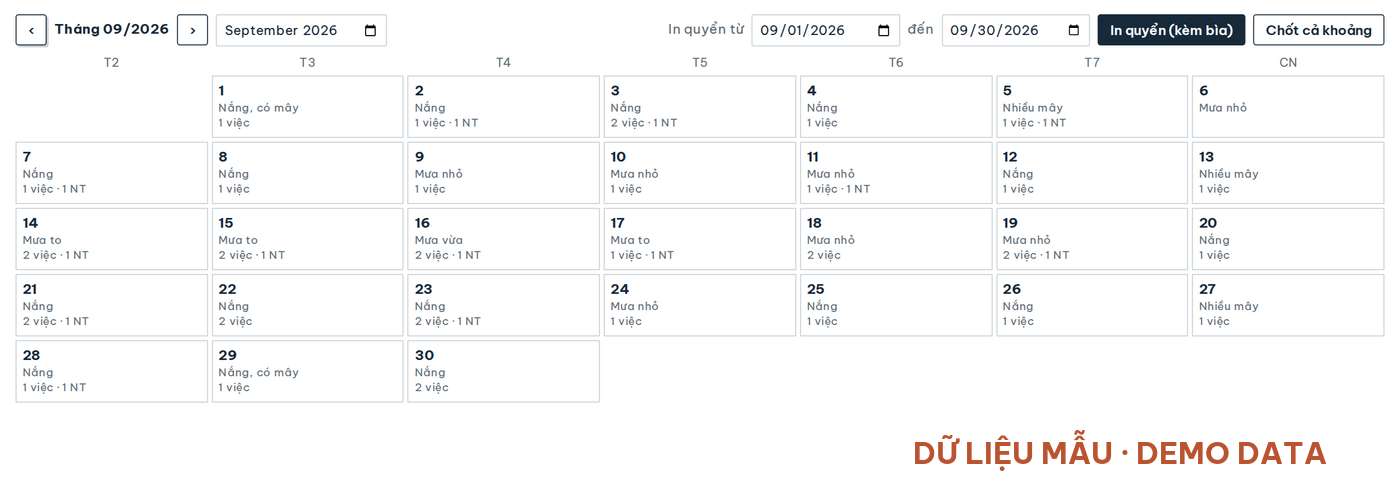
Vietnamese rules set no mandatory template for the construction diary, but it must record the weather, temperature, labour, equipment, the work done and the acceptances of each day (Decree 207/2026/ND-CP, Appendix IIa). So the print templates are data anyone can edit, not code.
2. First stream: diary pages
How to measure it. Time one week of diary as it is done now, printing included. The "after" minutes are measured by the tool itself: the moment a day is opened and the moment it is locked are both recorded.
How far to trust it: high. The pages are counted, the minutes measured over a week.
3. Second stream: acceptance records
How to measure it. Take last month's list of records, count them and ask the person who wrote them how long one takes. Records the supervisor sent back for a wrong figure belong to the fourth stream — do not count them twice.
How far to trust it: fair. The records are counted; the minutes vary a lot between a record with one quantity line and one with many.
4. Third stream: the statement of completed quantities
How to measure it. Next time a payment file is prepared, note when it starts and when it is submitted. Do the next one on the tool and compare like with like — a period full of new work items is not a period of finishing work.
How far to trust it: fair. One period a month is an assumption; many publicly funded projects pay less often — change that field.
5. Fourth stream: documents sent back
How to measure it. Count the pages the supervisor or the owner sent back over the last three months, and the reason for each. Only the reasons a machine can check (dates, order, quantities) belong here.
How far to trust it: low — the softest line. Set both shares equal and the calculator still shows 42.0 hours a month.
6. To subtract: setup
Each site needs its file imported, the suggested quantity links and order confirmed, the signatories and coordinates entered: about 4 hours. Spread over 10 months of construction, 2 sites cost 0.8 hours a month. None of this uses AI, so there is no model cost.
7. Adding it up
| Stream | Hours/month | Value/month (60,000 VND/h) |
|---|---|---|
| Diary | 14.7 | 0.88 M |
| Acceptance records | 18.1 | 1.08 M |
| Statement of completed quantities | 10.0 | 0.60 M |
| Documents sent back | 2.8 | 0.17 M |
| Setup | −0.8 | −0.05 M |
| Given back | 44.8 | 2.69 M |
About 45 hours a month, close to six working days, for one engineer looking after two sites. Today the paperwork takes about 54 hours; the machine takes over about 84% of them.
Count it once. Those 45 hours are money — 2.7 million VND a month, 32 million a year at the salary in the example — or the capacity for the same engineer to take on another site. Never both. For a small contractor the real value often lies in the second, but that is the company's decision, not the calculator's.
8. What this ROI stands on
The plan has to be kept true. That assumption sits under all four streams. A diary generated from the schedule is only right when the schedule is; if the real work drifts away from it and nobody updates it, the machine will neatly pre-fill wrong pages. That is why the diary stays a draft until the engineer locks the day — and locking it is where a person still has to work.
Automatic weather is a station reading, not the site's. Each grid cell is several kilometres wide; a local shower may not be in the reading. The weather field can be edited, and an engineer's own entry is never overwritten.
The standard order is a suggestion, not a law. Some jobs overlap for good reasons. A ⚠ only says the job starts earlier than the order allows; the engineer still decides.
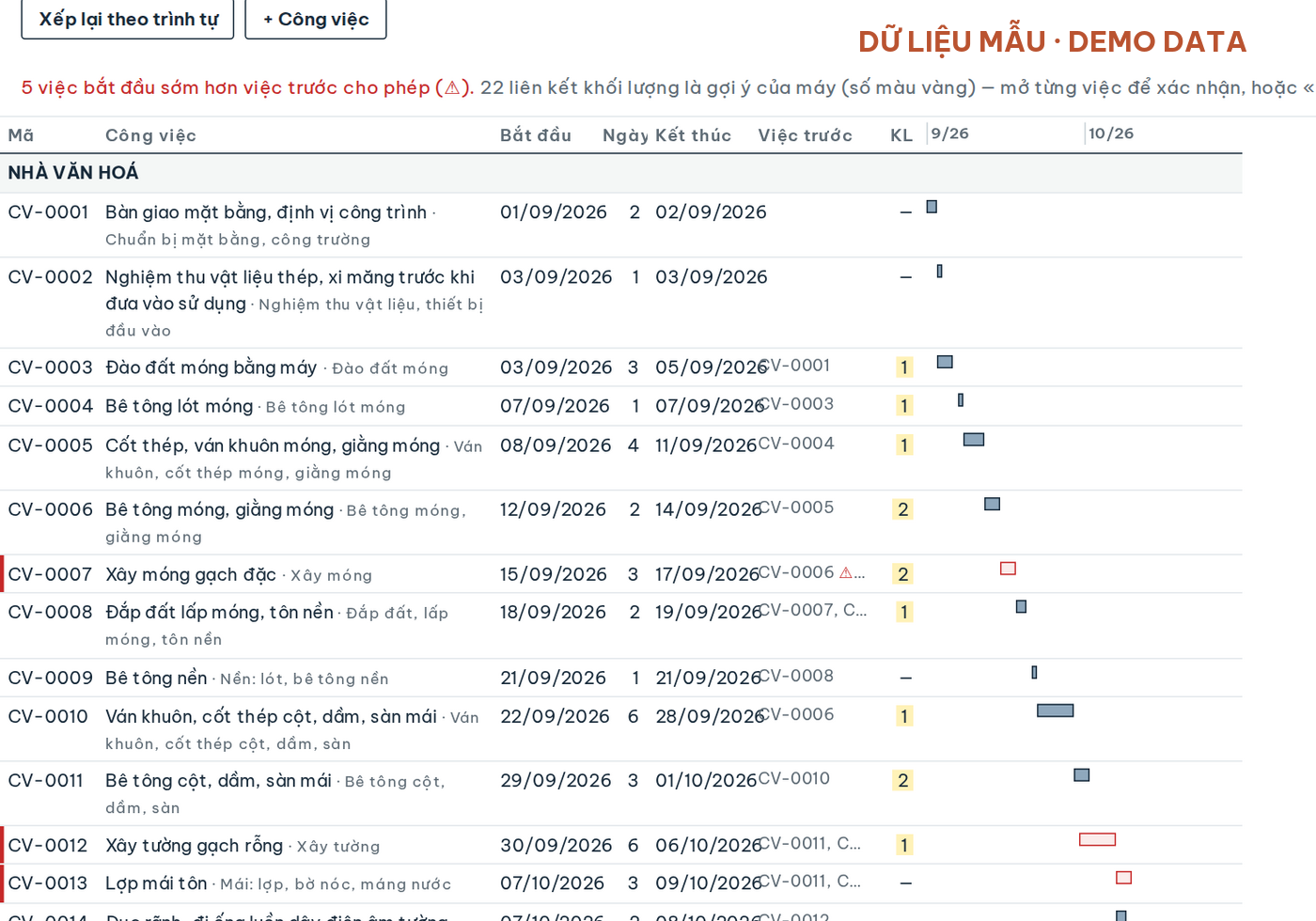
Machine-suggested quantity links must be confirmed. They are suggested by how alike the wording is; a wrong line joined to a record is a wrong line printed beautifully. Until confirmed, it reaches neither a record nor a payment.
9. Measuring it in your own company
- Take a baseline. One week: time the diary, count the acceptance records and the hours to write them; the hours spent on the last quantity statement; the pages sent back over three months.
- Run one site for one month. Note the setup hours. Each week, note the days locked, the quantity links confirmed, the jobs marked ⚠ and how many of those overlap on purpose.
- Compare like with like. A foundation month has more records than a finishing month; compare foundations with foundations.
10. What to remember
A job should be typed once. When the price annex, the schedule, the diary and the acceptance records are four hand-typed copies of the same event, each looks right and none checks the others. Join them with one code, and a "Sunny" diary page on a rainy day becomes the hard thing to produce instead of the easiest.
A site diary is not valuable because it is thick. It is valuable when every line in it says what actually happened.
The share of schedule rows copied from the price annex, the records per job and the "Sunny" diary on every day were measured on a real construction-management workbook, anonymised. The rainy days come from archived weather readings for that area and month. The number of sites, the minutes, the salary and every assumption in the calculator are illustrative. Replace them with your own.
Read next
-
Never invoice twice: ask the accounting ledger before creating — 199 of 209 invoices were already there
When invoicing moves from the accounting package into the ERP, there is a stretch when both create invoices. If the ERP asks the accounting ledger before it creates one, how many duplicates does a cutover avoid — and what is each duplicate you never clean up worth?
-
Sharing an estimate by one link: what the mailed-Excel loop costs, and "which version is the latest?"
An estimate passes through 2–4 people as Excel files sent by mail, so someone always asks "which version is the latest?". When the whole set — drawings, quantity table, where every number comes from — sits behind one shared project, with people invited by email or sent a view-only link that needs no account, how many hours a month does the review loop get back?
-
Invoicing at the original PO price: the delivery note says 21,000, the chain's PO says 30,000
A retail chain pays the price on its own PO, not the price on the supplier's delivery note. When a machine reads the PO price, invoices at it when the gap is plausible and corrects the price list for next time, what is that worth a month — and which lines still need a person?