Measuring the value
Try it without signing up: how soon an estimator sees a first result on their own file, against waiting for a demo
Software for estimators is usually sold through a demo: leave your number, book a slot, watch a sample project, and only then try your own file. When opening the page is enough to start — one project, upload an estimate and drawings, sign up only to keep the project or to use the AI — how many hours and how many days does finding out "does this fit us?" cost, and when does it save nothing at all?
Finding out whether a tool fits your own files: book a demo, or open it and try?
All it needs is how many people evaluate, an hourly cost, the days you wait for a demo slot and what a month of the tool is worth if it fits. Hours, days and the cost of each branch follow. Everything is editable.
Derived from the four numbers above (one evaluation)
Assumptions — open to see and edit each one
The demo
Trying it
Outcome
This is an estimate, not a promise. Line B is the softest — it stands on a monthly value you guess yourself. Set the share the trial shows and the minutes trying to 0: every line goes to 0. An honest model has to do that.
Software for estimating engineers is usually sold through a demo. Leave a phone number, wait for a call back, book a session when both the engineer and the department head are free, watch a sample project run smoothly — and only then get to try it on your own files. Two people at an hour and a half each, plus half an hour of back-and-forth scheduling and an hour of trying afterwards: 4.5 hours, and several days on the calendar.
The real question is only one: does this tool work with my files? The demo cannot answer that, because it runs on the seller's files.
This piece asks: if opening the page lets you use it right away with your own files — no email, no password — how many hours and how many days does it take to find out "is it a fit or not", and when does it save nothing at all?
1. What changes
Opening g20.erpkaizen.com takes you straight into the Xây dựng G20 tool. A browser that is not signed in is given an anonymous trial account: no email, no password, and the browser remembers it through its login session. That account follows every data-separation rule a real account does — only the person who opened a project sees it — and its address sits on a domain that never receives mail.
The trial does everything that needs no AI right away:
- Upload an
.xlsestimate and check its arithmetic in one pass. - Upload
.pdfdrawings, view them and search their text, scanned pages included once the machine has recognised the text. - Read the rebar schedules in the drawings, take quantities from
.dxffiles.
The limits, read from the running configuration: 1 project, 50 drawing pages in total, at most 30 MB per file, data kept for 7 days and then deleted automatically. Each network address can create at most 5 trial accounts a day.
You have to sign up when:
- you want to keep the project for good or work on more projects — a free account has 3 projects and 300 pages a month. Sign up in the same browser and the project you are trying is moved to the new account;
- you want to use the AI assistant — questions and answers about the files, making Excel files or files for G8 (Dự toán G8, a Vietnamese estimating program). The assistant needs a signed-up account and a plan; a trial that presses ask gets a sentence saying exactly that, not a mysterious error.
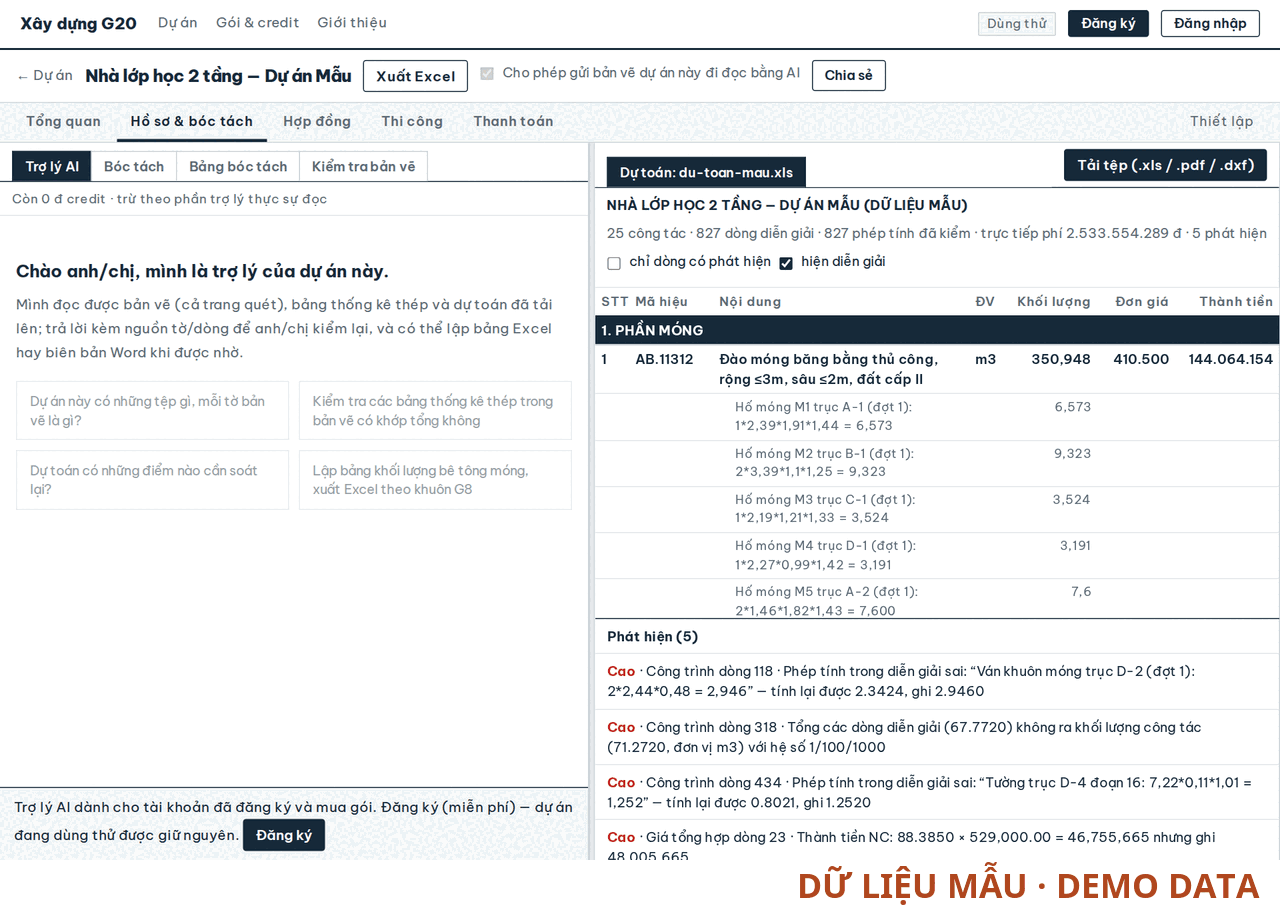
How it was checked. On our test machine: the trial account was ready 1.1 seconds after opening the page; a sample estimate of 25 work items and 827 take-off lines was checked in 1.1 seconds from the start of processing. The test suite for the trial flow runs through the real HTTP layer — keeping the session, blocking a second project, blocking plan purchases, blocking AI, moving the project on sign-up, not letting one trial take another trial's project, the per-address limit, cleaning up expired accounts: 14/14 green. On the real server the check is queued for a background process, so it may take a few seconds longer.
2. First stream: the hours of the people evaluating
The "share the trial shows" is what decides it. Whatever needs no AI — the arithmetic check, reading drawings, rebar schedules — can be seen right away on your own files. The AI part cannot: if what you need to know is whether the assistant's answers are good, the trial cannot answer that for you.
How to measure it. Think back to the last time your company evaluated a piece of software: how many people sat in, how many sessions, how many scheduling emails.
How far to trust it: fairly, for the hours. The 60% is your number — list what needs to be seen and mark which items need no AI.
3. Second stream: the days of waiting
Waiting days only cost money when the tool fits: each day of waiting is a day it has not yet given hours back to you. If it does not fit, those days are just time spent waiting to hear a "no" — the money is in the first stream.
How to measure it. The value of one month is your own estimate for the tool in question — the piece checking an estimate's arithmetic in one pass is one way to build that number.
How far to trust it: low — the softest stream, because it stands on a value that has not been measured.
4. Adding it up
| Per evaluation | Book a demo | Try it first |
|---|---|---|
| Hours of the people evaluating | 4.5 hours | 2.8 hours (expected) |
| First result on your own files | after 5 days | within half an hour of trying |
| If it does not fit | 450 thousand | 280 thousand |
| If it fits (waiting days included) | 700 thousand | 380 thousand |
| Expected cost | 575 thousand | 330 thousand |
A difference of 245 thousand VND per evaluation — 170 thousand in hours, 75 thousand in waiting. Not a number that changes a company, and this piece does not pretend otherwise. What changes is the order: the first result on your own files arrives before anyone's calendar has to be rearranged, and a "not a fit" costs 280 thousand instead of 450 thousand — just half an hour of two people's time if everything that needs to be seen is in the trial.
Count it once. These hours are money or the capacity to do other work. Never both.
5. What this ROI stands on
The trial shows what you need to see. That is the assumption under both streams. If what you need to know is the AI part, set that share to 0: the saving disappears and the half hour of trying becomes a loss, about 100 thousand VND. The calculator says exactly that.
You have your own files to upload. An .xls estimate exported from the estimating software you use, drawings within
the limit of 50 pages and 30 MB per file. A larger drawing set needs a sign-up (free) to be tried in full.
Putting real files on a service is a decision. The trial separates data like a real account, but a client's document set may come with confidentiality terms. Read the contract first; or try with a set that is finished and that you are allowed to use.
Seven days, then deleted. Without signing up, the work on a trial is lost after 7 days — for one evaluation, usually enough.
Measured on a test machine, not the real server. 1.1 seconds is the time on the test machine; on the real server the check waits for a background process. The page has been open since 29/10/2026; a few days is not enough to say how many people tried it and then signed up, so this piece gives no such number.
6. Measuring it in your own company
- Take a baseline. The last software evaluation: how many people, how many hours, how many days from the first contact to the first result on your own files.
- Try it with a finished set. Open the page, upload last month's estimate, time how long until the first finding. Note down what you still want to see that the trial does not show — that is your 60%.
- Compare like with like. Compare one evaluation with another evaluation, not with a purchase that was decided in advance.
7. What to remember
The question "does it fit my files?" can only be answered with your own files. Everything standing in front of that answer — forms, calls, appointments — is cost, not information.
A demo shows the tool working with the seller's files. Only a trial shows it working with yours.
How trial accounts are issued, the limits, and what needs a sign-up and what needs a plan are described as they stand in the Xây dựng G20 tool at the time of writing; the limits were read from the running configuration. The 1.1-second time and the 14/14 result were measured on a test machine; the screenshot comes from a sample project. The number of people, demo hours, waiting days, share the trial shows, probability of a fit, value of one month and salary are illustrative. Replace them with your own.
Read next
-
Make-up orders from a supermarket chain: one PO in 26, and only the receipt tells
A store raises a PO and receives it the same day to pay back goods already delivered without one. The PO header still says "deliver tomorrow", so a make-up order is easily delivered twice and the goods behind it never invoiced. Measured on 1,258 POs, with a matching threshold chosen from the data.
-
One screen for a delivery crew's day: 43% of notes posted before the truck delivers, and returns nobody can record
The warehouse posts the delivery note as the truck leaves; the driver's screen read it as "done" and locked the returns field. Over 14 days, early-posted notes had a signed slip 1% of the time and a returned quantity 0.4%, against 89% and 15.5%. Reopen the note for the driver, add a vehicle & fuel tab that reads photos with AI — what that saves a month.
-
Exceptions that arrive with a reason: 82 slips to check, but only 68 need someone to think
When invoices to supermarket chains raise themselves, the remaining slips reach the accountant with a reason in words. Read by what has to be done, the reasons fall into three kinds: judgement, wait, one-time fix. Measured on 291 slips, and the price of the minutes spent searching.