Measuring the value
Checking an estimate's arithmetic in one pass: 827 formulas, and a person reads only the flagged rows
Re-checking every formula of a 263-item estimate by hand takes about 4.6 hours, so nobody checks all of it. When the machine recomputes everything in one pass and flags only the rows that are wrong or suspicious, how many hours does an estimating engineer get back, and how much wrong money stops reaching a bid or a payment claim?
What does re-checking an estimate's arithmetic by hand cost, and how many errors still get through?
All it needs is the estimates you check each month, the formulas in one, the direct cost and an hourly cost. Hours, errors and the value of one work item follow from those. Everything is editable.
Derived from the four numbers above (per month)
Assumptions — open to see and edit each one
Checking by hand today
When the machine recomputes every formula
Errors and money
This is an estimate, not a promise. Line B is the softer one — set errors per 1,000 formulas to 0 (as on the real estimate in this article) and read it again. Set the seconds and minutes to 0 as well: the total is zero. An honest model has to be able to do that.
One real estimate, 263 work items. Inside its quantity take-off lines sit 827 formulas of the form "6*1,4*1,4*1,5 = 17,64". On top of those: 248 places where take-off lines are summed into an item's quantity, 263 places where a quantity is multiplied by a unit price, and a summary sheet that adds up the sections, the VAT and the after-tax total. Re-checking all of it on a calculator, at about 20 seconds a formula, is roughly 4.6 hours per estimate. So nobody checks all of it. People check the big-money lines, run an eye down the rest, and hope.
This piece asks: if every formula is recomputed in one pass and a person reads only the rows that are flagged, how many hours does an estimating engineer get back, and how much wrong money stops getting out?
1. What changes
The engineer uploads the estimate as an .xls file, exactly as exported from the estimating software already in use. The machine reads every work item and every take-off line, then recomputes:
- The arithmetic inside a take-off line. "52,6*0,7*0,1 = 3,862" recomputes to 3.682 and is flagged.
- The number written in the text against the quantity cell. The text says 1.742, the cell beside it says 1.472: one of them is a typo.
- The product of the dimensions (count × length × width × height × factor) against the quantity cell.
- The sum of the take-off lines against the item's quantity, allowing for the 1/100/1000 factor when the unit is 100 m³ or tonnes.
- Amount = quantity × unit price for materials, labour and plant.
- The summary sheet: the sum of the sections, the VAT, the after-tax total.
- Things worth a second look even when not certainly wrong: one code carrying two different unit prices, a take-off line repeated word for word inside one item, an item with a zero or negative quantity.
Each finding names the sheet and the row, with the recomputed value and the one written. A row with nothing wrong is not flagged. The check uses no AI, so it has no model cost.
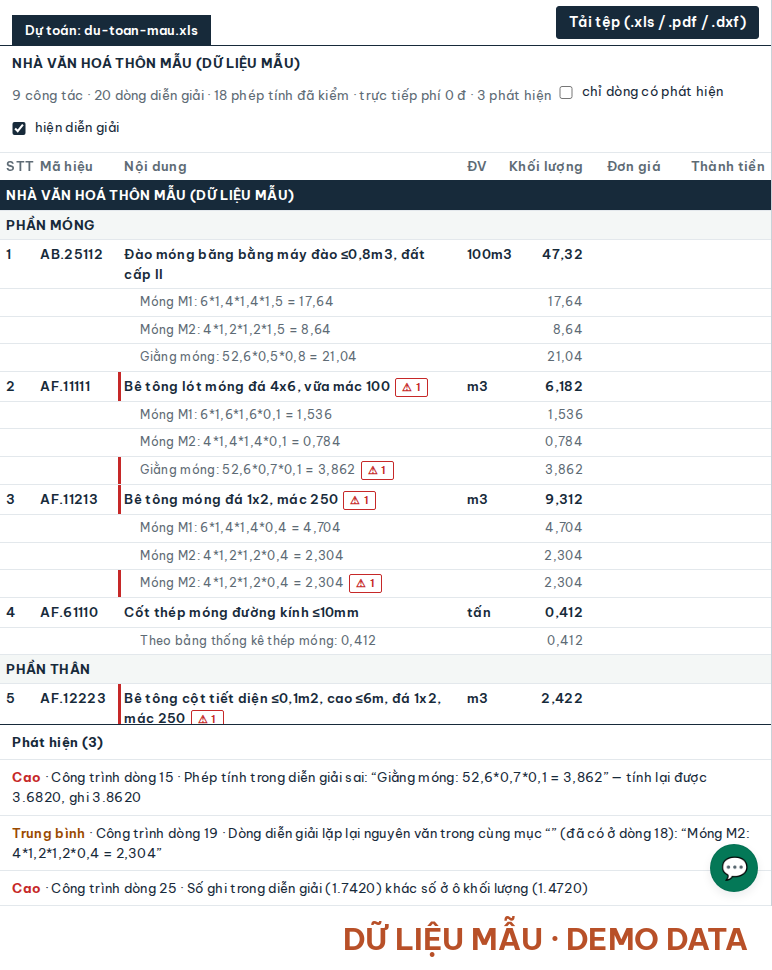
On the real estimate described at the top, the whole pass ran in under a second. The result: no arithmetic errors at all, and exactly one thing for a person to look at: a code carrying two different composite unit prices, about 23,800 and 18,300 dong a metre. That may be entirely right, because the materials or site conditions differ. But instead of 827 formulas, the reviewer reads one row.
2. First stream: hours of checking by hand
How to measure it. Time one full check by hand of one estimate, and count how many formulas actually got recomputed. The share that really gets recomputed is usually lower than people think.
How far to trust it: fairly. The formula count comes from the file; the seconds and the share checked have to be measured on the person who checks.
3. Second stream: errors that no longer get out
An arithmetic error in an estimate does not stay in the file. In a bid, an overstated quantity raises the price and can lose the tender; an understated one wins it with a loss-making item. In a payment claim it becomes an amount the reviewer or auditor cuts back, or an overpayment nobody reclaims.
How to measure it. Take three estimates you have already submitted, let the machine re-check them, and count how many flagged rows are real errors. That is your company's own errors per 1,000 formulas. For errors that reached a payment claim, ask the people who handle payment which amounts were ever cut for an arithmetic mistake.
How far to trust it: low — the softest stream. The real estimate at the top had no arithmetic errors at all. Set the error rate to 0 and the calculator still shows 0.85 million a month, all of it hours.
4. Adding it up
| Stream | Per month | Per year |
|---|---|---|
| Hours of checking by hand (8.1 hours) | 0.81 m | 9.7 m |
| Errors that no longer get out (3.5 errors) | 0.89 m | 10.7 m |
| Total | 1.71 m | 20.5 m |
Amounts in millions of dong.
Count it once. Those 8 hours are money or the capacity to check two more estimates a month. Never both.
5. What this ROI stands on
The machine checks arithmetic, not drawings. If the take-off line says "52,6*0,7*0,1" and the tie beam on the drawing is 48.2 m long, the arithmetic is right and the machine stays silent. Whether the take-off matches the drawing, whether the norm code fits the work, whether the price fits the market: those are still the engineer's questions. The machine does the adding and multiplying, and only that.
The arithmetic has to be written down. The machine can only recompute what is in the file: take-off lines with an "=", the dimension columns, the quantity and amount cells. A quantity typed straight into a cell with no take-off gives it nothing to check. On the real estimate at the top all 827 formulas were readable; another company's files may differ, and that is the "share the machine can read" field in the calculator.
A flagged row is not a wrong row. "Same code, two prices" usually has a reason. The machine says what it sees, with the numbers; a person decides.
6. Measuring it in your own company
- Take a baseline. Time one full check of one estimate by hand, and write down how many formulas really got recomputed.
- Let the machine re-check three submitted estimates. Count the flagged rows, and how many are real errors and how many have a reason.
- For a month, machine first, person second. Log the time spent reading results. Compare like with like: a renovation estimate with many short take-off lines is not a new-build estimate.
7. What to remember
Leave all the adding and multiplying to the machine, and leave the drawings to the person. When checking the arithmetic costs 4.6 hours an estimate, people check half and trust the rest. When it costs a second, all 827 formulas get checked, and the engineer's time goes to the questions a machine cannot answer.
The earlier piece on a site diary generated from one plan makes the same point on the building site: a number should be typed once, and then checked by the machine everywhere it travels.
The item count, formula count and check result (no arithmetic errors, one code with two prices) were measured on one real estimate, anonymised; the run time was measured on a test machine. The estimates per month, seconds, share checked, errors per 1,000 formulas, error size and every other assumption in the calculator are illustrative. Replace them with your own.
Read next
-
Never invoice twice: ask the accounting ledger before creating — 199 of 209 invoices were already there
When invoicing moves from the accounting package into the ERP, there is a stretch when both create invoices. If the ERP asks the accounting ledger before it creates one, how many duplicates does a cutover avoid — and what is each duplicate you never clean up worth?
-
Sharing an estimate by one link: what the mailed-Excel loop costs, and "which version is the latest?"
An estimate passes through 2–4 people as Excel files sent by mail, so someone always asks "which version is the latest?". When the whole set — drawings, quantity table, where every number comes from — sits behind one shared project, with people invited by email or sent a view-only link that needs no account, how many hours a month does the review loop get back?
-
Invoicing at the original PO price: the delivery note says 21,000, the chain's PO says 30,000
A retail chain pays the price on its own PO, not the price on the supplier's delivery note. When a machine reads the PO price, invoices at it when the gap is plausible and corrects the price list for next time, what is that worth a month — and which lines still need a person?