Measuring the value
Ask the project, get the sheet and the row: how many minutes must a question save to be worth paying for?
Each project gets an assistant that works only on that project's drawings and estimate, and every answer links to the exact drawing page or estimate row. Nine questions measured on the live system cost 5,107–78,852 dong each. This piece works out the break-even point, and why quick look-ups are still better done by hand.
How many minutes must one question about a project save before it is worth paying for?
All it needs is the questions a month, the minutes it takes to find an answer yourself today, the AI cost of one question and an hourly cost. The break-even point follows from those. Everything is editable.
Derived from the four numbers above
Assumptions — open to see and edit each one
When you ask the assistant
The reviewer (lead engineer, checker)
This is an estimate, not a promise. A wrong answer is not a side line: it eats into line A. Set the minutes "when asking" equal to today's, the wrong share to 0 and the AI cost to 0: the total is zero. An honest model has to be able to do that.
A 171-page drawing set and a 263-item estimate. A question like "how many openings did the estimate deduct from the exterior wall paint, and how many does the elevation actually show?" has its answer scattered over several elevation sheets, a door schedule and one take-off line. Finding it by hand means leafing through the set, counting, scanning the estimate, then writing it down so someone else can check: half an hour is ordinary.
That exact question was asked on a real project. The assistant answered that the estimate deducted 20 openings while the elevation shows about 23, with the page of each sheet and the estimate row. The AI cost of that question: 11,130 dong.
This piece asks: when each project has an assistant that works only on that project's documents, and every answer links straight to the drawing sheet or estimate row its number came from, how many minutes must one question save before it is worth paying for?
1. What changes
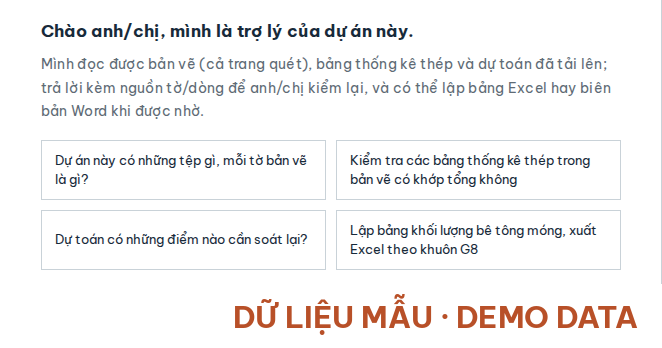
- One project, one assistant. The assistant has only tools that work on that project's documents: the file list, the text on each page, an image of a page or a zoomed region, a text search across the whole set, the estimate's work items and take-off lines. It has no tool to run commands, read files or go online. Every tool call carries a key signed for exactly one project, so text planted inside a drawing cannot reach another project.
- Every answer leads back to its source. "page 78" in an answer is a link that opens that sheet; "row 286" scrolls the estimate to that row. The reader checks a number with one click.
- Results come out as files. Ask for a table and you get an Excel file whose totals are formulas, not typed numbers; ask for a record and you get a Word file.
- You pay the real cost. Each question is charged exactly its model cost, after it has been answered, and a question can never spend more than the balance left.
2. What one question costs
On the live system the first 9 questions (29–30 October 2026) cost between 5,107 and 78,852 dong each; the middle one was 32,508 dong. A question that only reads text is cheap; one that has to look at many drawing images costs far more. At 100,000 dong an engineer-hour, the middle question is worth 19.5 minutes of work. That is the break-even point: a question that saves less than that is cheaper to look up yourself.
3. First stream: hours finding answers yourself
A wrong answer is not a side line. When the source shows it is wrong, the minutes spent reading it are lost and the search starts again from scratch.
How to measure it. For two weeks, every time you have to leaf through the documents to answer something, write down the question and the minutes. That is your own list of questions and your own "today" minutes.
How far to trust it: fairly on the minutes, low on the wrong share. The share of wrong answers has not been measured. In one internal test, where an AI read a document set and wrote its own findings, 4 of 15 findings were wrong. That is exactly why every answer has to carry its source. Set the wrong share to 27% to see that scenario: the total drops to 0.23 million a month.
4. Second stream: the reviewer tracing sources
A number in a review report or a comparison table is only trustworthy when the reviewer can find it again on the drawing. Today that is one more trip through the set.
How far to trust it: fairly. Most of the value here is not hours but trust: a number that clicks back to its page needs nobody to take anybody's word for it.
5. To subtract: the AI cost
6. Adding it up
| Stream | Per month |
|---|---|
| Hours finding answers yourself (15.3 hours) | 1.53 m |
| Hours tracing sources (3.3 hours) | 0.33 m |
| AI cost (40 questions) | −1.30 m |
| What is left | 0.57 m |
Amounts in millions of dong.
About 0.57 million a month, 6.8 million a year: positive, but thin. The AI cost eats more than two thirds of the hours saved. The real conclusion of the calculator is not the total but the break-even point: look up the quick questions yourself; ask the ones that mean leafing through half the set. At 23 minutes saved per question, 5 of the 9 measured questions cost less than those minutes are worth.
Count it once. Those 18.7 hours are money or capacity to take on more projects. Never both.
7. What this ROI stands on
A wrong answer has to show itself when the source is opened. The model treats a wrong answer as lost reading minutes, not as a wrong number that goes into a report. That only holds if the engineer actually opens the source before using the number. If not, the wrong share becomes a different cost altogether, and this calculator no longer describes it.
The cost of a question varies fifteen-fold. A question that looks at many drawing images costs more than one that reads text. The cost field should hold the average cost of the kind of question you actually ask, read from your own charge history, not the middle of the first 9 questions.
The assistant knows only what is in the documents uploaded. A sheet missing from the set has no page to link to, and the right answer is "not found".
8. Measuring it in your own company
- Take a baseline. Two weeks: log each question that needed the documents, the minutes, and which numbers the lead engineer had to trace.
- Ask the same kind of questions for the next two weeks. Log the cost of each, and mark the ones that turned out wrong when the source was opened.
- Split the questions at the break-even point. Stop asking the ones below it; compare the ones above with the ones above.
9. What to remember
An answer without a source is only an opinion. The assistant's value is not that it answers fast, but that every number it gives clicks back to its page, and the person asking knows exactly what that question cost.
The same idea in another piece: checking an estimate's arithmetic in one pass, where the machine points at the exact rows to look at instead of making a person read the whole estimate.
The cost of the 9 questions was measured on the live system (29–30 October 2026), at model cost. The openings example at the top and the 4-of-15 wrong findings come from real document sets, anonymised. The number of questions, minutes, wrong share, salary and every other assumption in the calculator are illustrative. Replace them with your own.
Read next
-
Never invoice twice: ask the accounting ledger before creating — 199 of 209 invoices were already there
When invoicing moves from the accounting package into the ERP, there is a stretch when both create invoices. If the ERP asks the accounting ledger before it creates one, how many duplicates does a cutover avoid — and what is each duplicate you never clean up worth?
-
Sharing an estimate by one link: what the mailed-Excel loop costs, and "which version is the latest?"
An estimate passes through 2–4 people as Excel files sent by mail, so someone always asks "which version is the latest?". When the whole set — drawings, quantity table, where every number comes from — sits behind one shared project, with people invited by email or sent a view-only link that needs no account, how many hours a month does the review loop get back?
-
Invoicing at the original PO price: the delivery note says 21,000, the chain's PO says 30,000
A retail chain pays the price on its own PO, not the price on the supplier's delivery note. When a machine reads the PO price, invoices at it when the gap is plausible and corrects the price list for next time, what is that worth a month — and which lines still need a person?