Read the IFC model into a component catalogue in the ERP, so estimating, purchasing, the shop and the site stop queuing behind the design software: the money comes from four sources, each can be measured in your own company, and the ROI still holds when you drop the source you are least sure of.
What is taking the model out of the design software worth?
All it needs is tonnes per year, the share of that tonnage with a usable IFC model, and the paid software seats held outside detailing. Every revenue-scale figure follows from those — and every one is editable.
Derived from the three numbers above
Assumptions — open to see and edit every number
Licences
Labour
Steel scrap
Rework from wrong marks
Time and cost
This is an estimate, not a promise. Line D is the softest — set it to zero and read the total again. Set the model share, the bid share and the seats to zero: every benefit goes to zero with them, and only the cost is left.
At a structural steel EPC contractor, the Tekla model is the most complete record of the building there is: every assembly, every part, every bolt, with its profile, length, weight and paint area. The trouble is that only the detailing team can open it comfortably. Estimating, purchasing, the shop, the site and accounts all need those numbers — and each of them gets hold of them in its own expensive way.
This piece works out the ROI of taking the model out of the design software: export it to IFC, read it into a component catalogue in the ERP, and let every department work from that catalogue instead of from the model. The money comes from four sources — software licences, labour, steel scrap, and rework caused by wrong piece marks. For each one, the piece shows how to calculate it, how to measure it in your own company, and how far to trust it.
1. How the model is used today, and what that costs
In most companies, the data in the model reaches the other departments by one of three routes:
- Buying more seats. Estimating, the shop, quality control and site engineers each hold a licence just to look at the model, plus a workstation powerful enough to open it.
- Exporting reports to Excel. The detailer prints a list of pieces and sends it round, and from then on each department keeps its own copy. When the model changes, those copies do not.
- Asking the detailer. Cheapest on paper, most expensive in practice: the person who knows the model best spends part of the day looking things up for everyone else.
All three cost money in four places: licence fees; hours spent counting, re-keying and reporting; steel bought by rule of thumb instead of by the parts that actually have to be cut; and the times a piece reaches site with the wrong mark, missing fittings, or out of erection order. None of them shows up as a line in a management report.
2. What the change consists of
The detailers keep Tekla. Everybody else uses the catalogue.
- Read IFC into a component catalogue. IFC is an open format that Tekla, Revit, SDS2 and Allplan can all export. The machine reads the file and writes every assembly, every single part and every bolt as a row in the ERP: piece mark, profile, steel grade, length, weight, surface area, and which zone it belongs to.
- One fixed mark per piece, from the model to the label. That mark is printed as a QR code; the shop and the site scan it to update the piece's status — material received, cut, welded, inspected, painted, shipped, erected, accepted. Accounts reads the same status to value work in progress and to build progress claims by quantity.
- The catalogue goes straight into purchasing. The list of parts by profile and thickness goes into nesting before the steel is ordered, so steel is bought for what has to be cut rather than by a standard allowance.
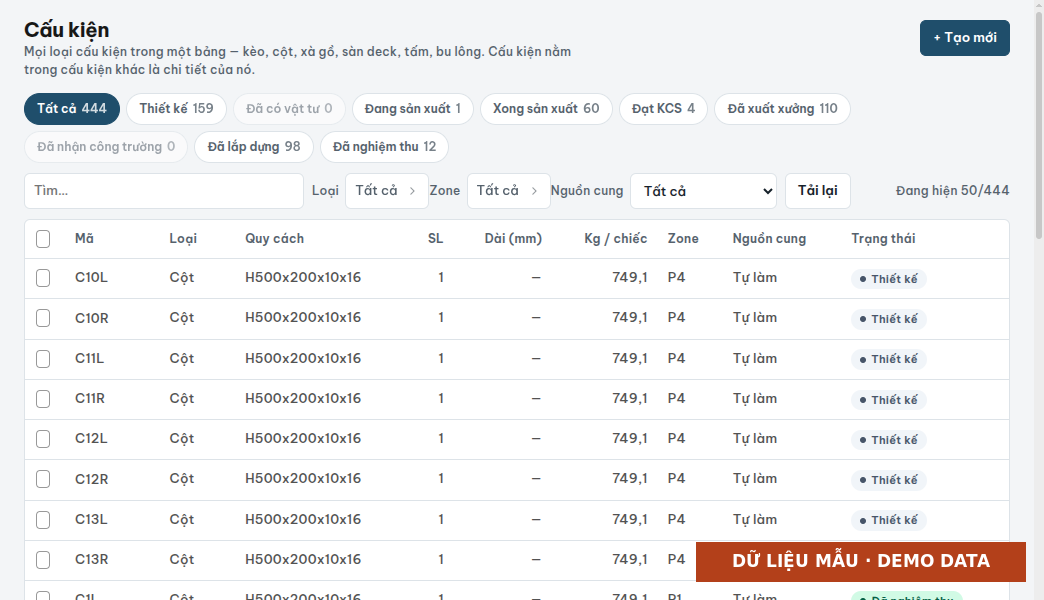
Tekla does not go away. The model simply stops being the place the whole company has to queue up to read.
3. First source: software licences
How to measure it. This is the only source whose number is already printed on an invoice. Pull the licence server log for the last 90 days: who opened the software, in which department, how often. Any seat used only to look at the model and look up numbers is a seat the catalogue can replace.
How far to trust it: the most — with a condition. If those departments already view the model in a free viewer, this line is zero, however good the arithmetic looks. And it only becomes money at renewal, when the licence contract is actually cut.
4. Second source: estimating and shop labour
The share of work that has a model is the factor most easily forgotten. At tender stage, most projects do not have a detailed model yet — it is usually built only after the contract is signed. Bids that arrive with nothing but 2D drawings take a different route, as the piece on reading drawings into a quotation worked out. The 50% in the example is a placeholder: count how many of your last 20 bids came with a usable IFC model. In the shop it is different — a signed project always has a model, because the company builds it.
How to measure it. Time three takeoffs before and after. In the shop, log for two weeks the time foremen spend on paperwork and end-of-day reports, before and after scanning.
When hours become money. As the piece on keyboard shortcuts put it, freed hours only become money when they go into work that has a price: less overtime, no new hire when volume grows, or moving people onto harder work. Submitting a bid faster — in days rather than weeks — is real, but it is the same hours used differently; the calculator does not count it a second time.
5. Third source: less steel scrap
The easiest mistake to make here is to value the steel saved at its purchase price. Offcuts are not a total loss — they become scrap, and scrap sells. Valued at the purchase price, the same 90 tonnes come to 1.5 billion, nearly twice the real figure.
How to measure it. For every finished project, compare the total steel bought with the total steel shipped as pieces; the monthly scrap sales invoices are the cross-check. Six to twelve months of data is enough to know your company's current scrap rate.
How far to trust it: medium, even though this is the largest source. Nesting software is a tool of its own; the catalogue only gives it correct data, earlier. If the shop already nests on its CNC machines, the reduction will be much smaller — which is why the scrap baseline has to be taken before you start, not after.
6. Fourth source: less rework from wrong piece marks
How to measure it. If the company keeps a non-conformance log, each entry already records its cause and the cost of putting it right; filter the ones that trace back to a piece mark, a quantity or a sequence. If there is no such log, the first job is to start one — and to keep it for three months before trusting any number in this line.
How far to trust it: the least. 0.1% is an assumption, not a measurement. Set it to zero and read the total again.
7. Adding it up — and the money does not start on day one
With the default assumptions in the calculator above, once the system is running in full:
| Source | Per month | Per year |
|---|---|---|
| Software licences | 47.3 M | 568.0 M |
| Estimating and shop labour | 34.8 M | 417.6 M |
| Less steel scrap | 65.3 M | 783.0 M |
| Less rework from wrong marks | 31.5 M | 378.0 M |
| Total at full run | 178.9 M | 2,146.6 M |
But no system runs in full from its first month. The shop needs time to get used to scanning, purchasing needs a few lots before it trusts the nesting lists, and licences can only be cut at renewal. The calculator ramps the benefit up over the first 6 months. With an investment of 500 million in the first year and 120 million a year after that for the server, support and updates:
- The first-year benefit is about 1.7 billion, not 2.1 billion.
- Payback comes in about month 5.3. If the system ran in full from day one, it would be month 2.8 — the gap between the two is the ramp-up, and it is the thing most often left out of a payback calculation.
- The first-year return on the investment is about 240%; over three years, about 710%.
The chart in the calculator stacks the sources by how certain they are: licences at the bottom, rework at the top. The top of each column is the softest part of the number.
8. What this ROI stands on
Two assumptions decide the most, and they are of different kinds:
- Steel scrap is the largest source — more than a third of the total — and also the hardest to attribute.
- Licences are all or nothing: either those seats are on the invoice, or they are not.
Lower each of them to see whether the calculation still stands:
- No seats to cut: 1.58 billion a year, payback in month 6.3.
- No seats to cut and no reduction in scrap: 796 million a year, payback in month 10.
- No seats, scrap down by only 0.35 points, rework at only 0.05%, and 9 months to reach full run: 972 million a year, payback in month 10.2, a first-year return of about 30%.
The last scenario still pays back within the first year. That is the number to take into the investment meeting, not 710%. And if you set the share of output with a model, the number of seats and the share of bids with a model all to zero, every benefit goes to zero with them and only the cost is left — exactly as an honest model should.
9. Measuring it in your own company
The first step has to happen before the change goes live — without a baseline there is no ROI.
- Take a baseline (four to eight weeks). The licence server log for 90 days. Time three takeoffs. The scrap rate of the projects finished in the last 12 months, from steel bought and steel shipped. Start a rework log if there is none.
- Pilot on one project. Read its IFC model into the catalogue, print the labels, have the shop scan them, and put the parts list through nesting before the steel is ordered.
- Measure again after three to six months, against your own baseline and like with like — sheds against sheds, multi-storey against multi-storey — so that a swing in steel prices or one unusually large project is not mistaken for a result of the change.
Licences and labour will be clear within a few months. Steel scrap and rework need a year of data to show — so do not make them a condition of approving the investment; track them as the upside.
10. What to remember
The model is where the data is created; the catalogue is where it is used. When the two are the same thing, every department queues behind one expensive piece of software and one person who knows how to use it. Separating them does not make the model any worse — it lets every number in it reach the person who needs it, under the same mark, from the drawing to the site.
Don't ask how much this software saves. Ask: if you drop the source of money you are least sure of, does it still pay back in the first year?
The figures in this piece are illustrative, for a structural steel contractor producing about 1,000 tonnes a month; they are not taken from any client's system. Licence fees, steel prices and scrap prices change over time — replace them with the numbers on your own invoices in the calculator above.